
Ilya Cech moderated a session on the interaction of science and business at the V Congress of Young Scientists
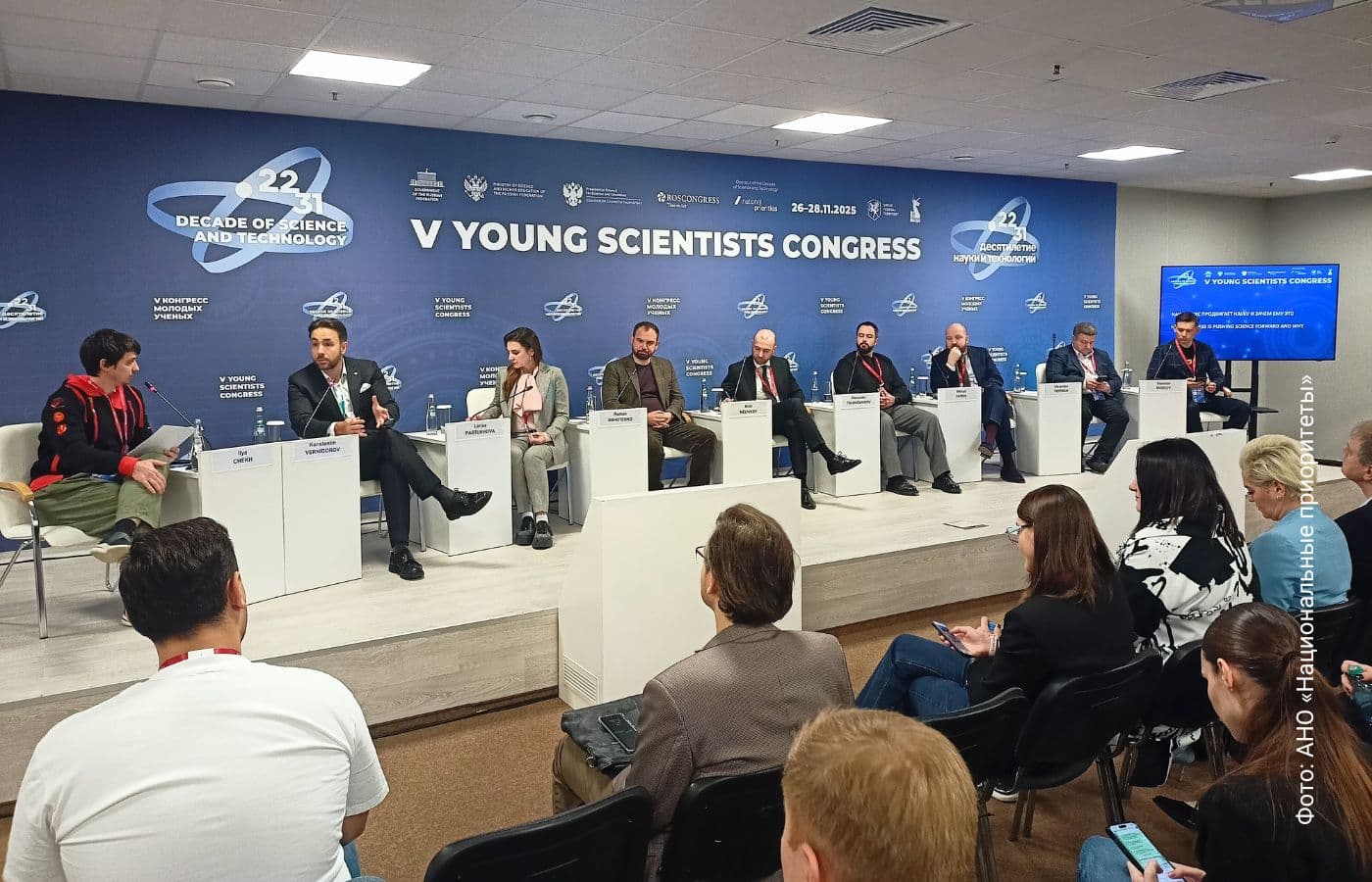
At the V Congress of Young Scientists, a discussion was held on "How business promotes science and why it needs it." The session was moderated by Ilya Cech, founder of the Frontiers of Science Scientific and Technological Guild.
We live in an important and dynamic time for science. The updated plan for the Decade of Science and Technology has been approved by the decree of the Government of the Russian Federation. Major companies, universities, and research teams are launching large-scale initiatives. By generating demand for new developments, businesses become full participants in technological development.
Ilya Cech, moderator of the session, founder of the Frontiers of Science Scientific and Technological Guild, began his speech with these words .
The dialogue between business and science is a key success factor. But which models of cooperation between enterprises and universities actually work? What role does your company play in the development of scientific and technological projects?
What drives a business
Konstantin Vernigorov (Sibur PolyLab) stated that the company's task is not just to produce polymers, but to replace imported technologies in the petrochemical industry: "If you do not have polymerization catalysts, there will be no finished product."
Larisa Pastukhova (Sistema Foundation) spoke about The school for young Scientists, which starts in February 2026. According to her, the bridge between the real sector of the economy and universities is just being formed, and it is important to show students how R&D centers work.
Aircraft industry and personnel
Roman Okhotenko (UEC) recalled that only five countries in the world are capable of creating competitive aircraft engines, and Russia is the only one where all production is concentrated at one enterprise. The key link between business and science is materials science. To attract young people, the UEC launches the All-Russian Olympiad with real tasks from design bureaus.
Kirill Melnikov (Melnichenko Foundation) called the outflow of personnel the main challenge. The solution is to develop educational talent centers in the regions (there are already 12 of them), where students are engaged in robotics and AI.
Startups and long-term relationships
Alexander Fertman (Skolkovo) noted that corporations rarely invest in early research, but startups test hypotheses faster. "In a sense, corporations bring the dream — challenges that startups respond to more quickly," he said.
Stanislav Moiseev (T-Technologies) emphasized the importance of long-term relations with universities. The company has launched master's degree tracks at MIPT (applied and scientific) and a student laboratory for young professionals from all over the country.
Who invests in science
Anna Kiselyova (Vedomosti. Zdorovye") presented the results of a study of 400 major Russian companies. Patent Leaders — Rostec, Rosatom and Roscosmos. Rostec's share of R&D costs is 7-8% Roscosmos has a third of its revenue for 2024. At the same time, private companies in Russia So far, they are inferior to the state in terms of investments in science, which differs from world practice.
Anatoly Smirnov (Helikon Company) called for promoting concrete scientists rather than abstract science: "They are the ones who are able to offer global ideas that will lead to real breakthroughs." The company holds grant competitions for undergraduates and masters in a wide range of topics in biology and biotechnology.
The participants agreed that the dialogue between business and science is a key factor in technological development. The government remains the main investor, but private companies are gradually increasing their activity. To retain staff, educational programs, internships in real R&D centers, and solving applied problems are needed as students.
The discussion was attended by:
- Andrey Blinov, Deputy General Director, The Russian Science Foundation;
- Konstantin Vernigorov, General Director, Sibur PolyLab LLC;
- Mikhail Vladimirovich Nikulin, General Director Gazpromneft – Industrial Innovations LLC;
- Igor Drozdov, Deputy Chairman, VEB.RF;
- Tatiana Zhuravleva, General Director, Melnichenko Foundation; Director of Social Programs, AIM Management LLC;
- Maxim Ivanov, Deputy Editor-in-Chief, Online edition of Vedomosti;
- Larisa Pastukhova, President, Sistema Charitable Foundation;
- Tatiana Terentyeva, Deputy Director General for Human Resources, Rosatom State Atomic Energy Corporation;
- Roman Okhotenko, Deputy Head of Administration, United Engine Corporation JSC;
- Mikhail Fatkin, Director, S+Consulting;
- Kirill Kaem, Deputy Chairman of the Management Board for Priority Areas of Technological Development, Chief Managing Director, Skolkovo Foundation;
- Alexander Tolokolnikov, Executive Director of ZEN.